EGCO, GULF, Yanhee seal 168MW Thai solar farm venture
EGCO Group, GULF, and Yanhee Power have finalized a joint venture for five solar farms totaling 167.60 MW under Thailand's renewable scheme.
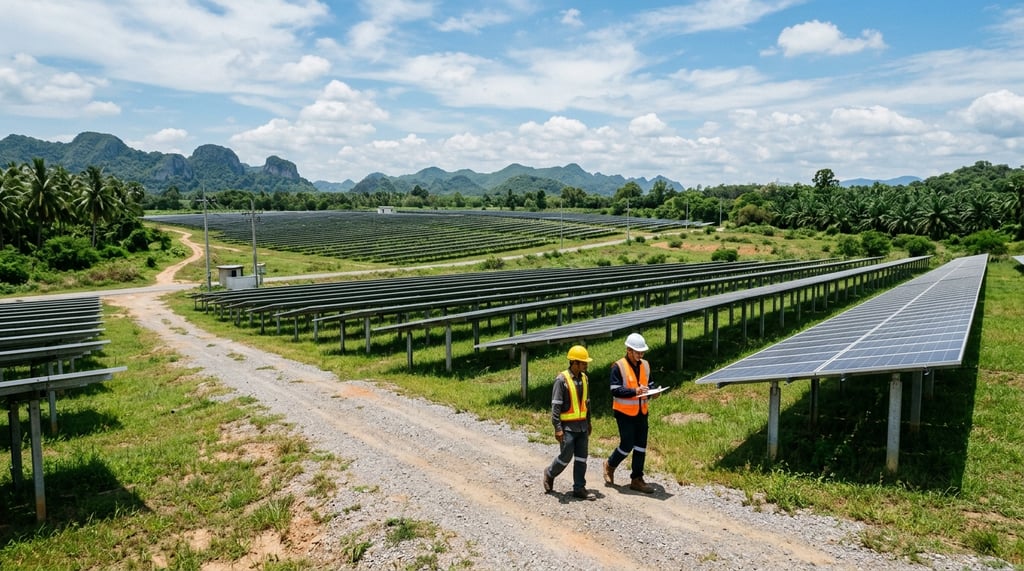
Three of Thailand's leading energy developers have closed a joint venture covering five utility-scale solar farms with an aggregate contracted capacity of 167.60 megawatts. The transaction, settled on November 25, 2026, restructures two special-purpose project vehicles awarded under Phase 2 of Thailand's Renewable Energy Big Lot scheme. The alliance aligns Electricity Generating Public Company Limited (EGCO Group), Gulf Energy Development through its clean power subsidiary, and healthcare-backed developer Yanhee Power Holding.
Under the transaction terms, EGCO Group transferred equity stakes in both project vehicles to its partners, unlocking approximately 218 million baht in immediate cash proceeds. The capital extraction strengthens EGCO's balance-sheet liquidity and bolsters its disciplined capital allocation, while preserving substantial co-ownership to capture recurring equity earnings once commercial generation begins.
The Mechanics of the 168-Megawatt Restructuring
The restructuring covers two operating entities holding 25-year state power purchase contracts. The first vehicle, EGCO Cleantech Company Limited, develops two Small Power Producer solar installations in Ratchaburi province totaling 48.60 megawatts contracted to the Electricity Generating Authority of Thailand. EGCO divested a 50 percent equity interest in Cleantech to Gulf Renewable Energy Company Limited (GRE), establishing an even joint venture.
The second entity, EGCO Cleanergy Company Limited, manages a 119.00-megawatt portfolio spanning three solar installations in Western Thailand. Two facilities qualify as Small Power Producers supplying EGAT in Suphan Buri and Kanchanaburi provinces. The third installation operates under the Very Small Power Producer classification in Suphan Buri, delivering power to the Provincial Electricity Authority. EGCO divested 37.50 percent of Cleanergy to GRE and 24.00 percent to Yanhee Power Holding. The post-closing shareholding leaves EGCO and GRE with 37.50 percent each, while Yanhee holds the remaining 25.00 percent.
Regulatory filings indicate GRE contributed 143.40 million baht in equity across both corporate vehicles. The overall transaction returns 218 million baht to EGCO, covering share purchases and prior capital costs paid by incoming partners.
Balance-Sheet De-Risking and Capital Discipline
The deal illustrates an evolving financing strategy among Thailand's top private power producers. Under its POWER4 blueprint, EGCO Group is prioritizing balance-sheet optimization over wholly owned asset ownership. Building large photovoltaic plants requires heavy upfront engineering commitments, land outlays, and grid connections. Monetizing equity during pre-construction allows developers to derisk assets, capture immediate liquidity, and preserve borrowing capacity.
Partnering with Gulf Energy Development gives the consortium considerable procurement leverage across international solar module suppliers and balance-of-system contractors. Construction across all five project sites will start during 2027. Grid synchronizations will occur in phases, with initial commercial operation scheduled for 2028 and full delivery completed by 2030.
For EGCO, extracting 218 million baht in cash adds financial agility during an era of volatile global interest rates. The company avoids over-leveraging while retaining proportional profit sharing from long-term utility revenues.
The Industrial Pull: Data Centers and Green Tariffs
The venture coincides with growing corporate demand for renewable energy in Central Thailand. Industrial estates across the Central Plains are expanding electricity usage to meet decarbonization standards. In addition, global cloud providers constructing hyperscale data centers across Bangkok require dedicated green power contracts.
Thailand's Energy Regulatory Commission designed the RE Big Lot scheme to meet this corporate demand through predictable Feed-in Tariffs. Fixed 25-year contracts insulate the national grid from spot liquefied natural gas prices, which frequently drive up utility Fuel Tariff components during geopolitical disruptions.
Siting solar farms in Ratchaburi, Suphan Buri, and Kanchanaburi offers logistical benefits. Located near industrial hubs in Pathum Thani and Samut Sakhon, these plants limit transmission losses and supply peak solar electricity during afternoon air-conditioning surges.
What This Means for Thailand's Power Market and Residents
The joint venture highlights consolidation among domestic utilities. Consortia are replacing individual developers to pool engineering expertise, share grid interconnection costs, and secure competitive financing from domestic banks.
For businesses and residents across Thailand, expanding domestic solar capacity enhances grid security and dampens tariff volatility. Replacing imported gas with domestic solar reduces foreign currency exposure, promoting long-term power tariff stability.
The closing of this transaction demonstrates steady private sector confidence in Thailand's clean energy transition. As ground teams mobilize in 2027, the five installations will provide a template for multi-party infrastructure financing supporting Thailand's digital economy.

Comment verification
Step 1 of 3
Verify your email once to publish your comment. Your email is never shown publicly.
Enter the 6-digit code sent to .
Choose the display name shown next to your comments.