Thailand mandates ADAS safety tech on PHEVs from 2027
Thailand's Excise Department has drafted stringent new vehicle tax rules requiring plug-in hybrid electric vehicles to carry at least two active driver assistance systems from January 2027 to qualify for preferential tax brackets.
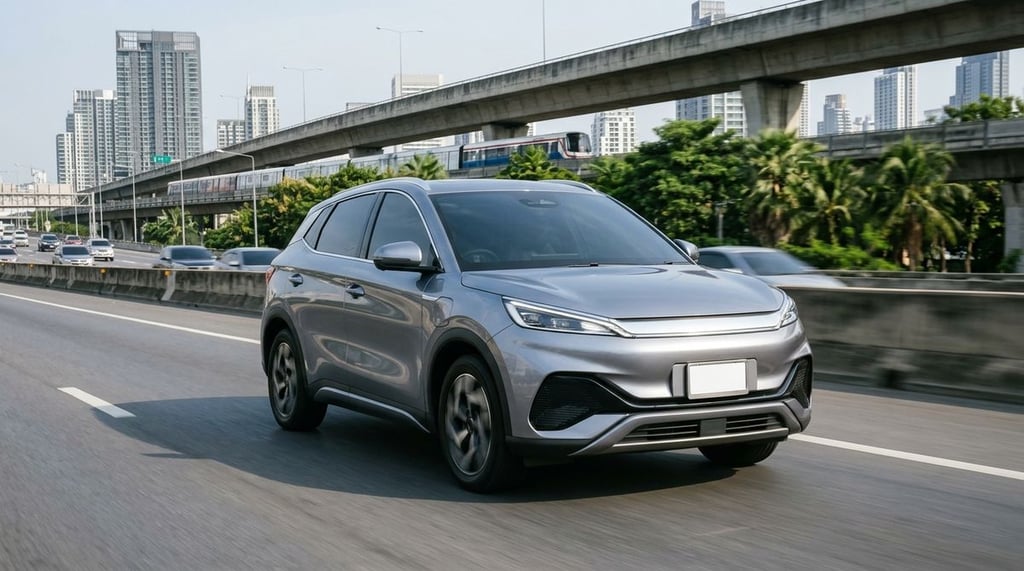
Thailand's Excise Department has finalized draft technical regulations governing passenger plug-in hybrid electric vehicles, introducing mandatory active safety equipment as a strict prerequisite for preferential excise taxation. Under the regulatory framework scheduled to take effect on January 1, 2027, every plug-in hybrid vehicle sold or imported into the Kingdom must feature at least two certified advanced driver assistance systems. Automakers failing to integrate the mandated technologies will lose access to concessionary tax rates, facing baseline vehicle duties that could significantly alter showroom pricing across the domestic market.
The draft notification enacts ministerial decrees approved by the Thai Cabinet following recommendations from the National Electric Vehicle Policy Committee. The measure alters longstanding classifications under categories 06.01 and 06.02 of the 2017 Excise Tariff Act. By conditioning fiscal incentives on tangible onboard electronics rather than sheer propulsion displacement, the Ministry of Finance is executing a dual-track policy. The initiative seeks to modernize national road safety baselines while forcing automotive assembly lines to localize sophisticated electronic component supply chains.
Regulatory Architecture and Safety Criteria
The regulatory schedule establishes a defined list of six qualifying technologies divided between primary intervention systems and peripheral driver alerts. To secure concessionary excise tax certification, manufacturers must incorporate at least two functions from the approved roster: autonomous emergency braking, forward collision warning, lane keeping assist, lane departure warning, blind spot detection, or adaptive cruise control. The equipment must be standard factory hardware rather than optional dealership packages.
Verification protocols will operate through Thailand's centralized ECO Sticker digital portal administered by the Ministry of Industry and the Excise Department. Automotive manufacturers and licensed distributors must submit comprehensive engineering documentation, owner operation manuals, and formal test certificates from accredited institutions such as the Thailand Automotive Institute or the Electrical and Electronics Institute. Domestic assembly plants must present certified declarations to provincial excise officers before finished units clear factory gates, with a strict 45-day window for provisional filings to finalize documentation.
Decoupling Range From Arbitrary Fuel Caps
The safety mandate works in tandem with fundamental structural reforms to the underlying hybrid tax formula. Under legacy legislation, Thai tax law penalized plug-in hybrids whose fuel tanks exceeded arbitrary physical capacity limits, regardless of battery pack size or tailpipe emissions efficiency. That historic restriction conflicted directly with European and American automotive engineering standards, deterring global brands from manufacturing international-spec electrified models at their Rayong and Chonburi industrial plants.
The updated framework eliminates mechanical fuel tank caps entirely, substituting an objective performance benchmark based solely on single-charge pure electric range. Passenger vehicles delivering an electric-only driving range of 80 kilometres or greater qualify for a reduced 5 percent excise duty. Models providing an electric range below the 80-kilometre threshold pay a 10 percent levy. By removing artificial fuel tank restrictions and introducing the ADAS threshold, regulators have aligned domestic fiscal policy with global platform engineering while encouraging higher-density battery configurations.
Alignment With Wider Tariff Protectionism
The introduction of the 2027 safety criteria cannot be viewed in isolation from Thailand's broader automotive industrial defensive strategy. From January 1, 2027, the government will simultaneously raise excise taxes on fully imported battery electric vehicles and range-extended electric vehicles from baseline promotional rates up to 35 percent. That sharp tariff escalation is engineered to shield domestic automotive suppliers from an influx of low-cost completely built-up imports that bypass local manufacturing commitments.
By compelling plug-in hybrid builders to assemble camera modules, radar sensors, and digital braking controllers within domestic supply chains, the Board of Investment and Excise Department are attempting to upgrade the technical complexity of Thailand's auto parts sector. Traditional Tier 1 and Tier 2 suppliers that long dominated internal combustion engine component manufacturing must pivot toward electronic sensor integration, wiring harness modernization, and embedded software validation to retain their commercial relevance.
What This Means for Expats in Thailand
For foreign residents, corporate transferees, and long-term expatriates planning automotive acquisitions or evaluating operating leases, the impending 2027 rules carry direct commercial consequences:
- Standardized Active Safety: Budget-conscious or entry-level plug-in hybrids sold after 2026 will no longer strip out automated braking or blind spot sensors as cost-cutting measures. Foreign drivers navigating high-speed highways and congested urban arterials will benefit from higher baseline active safety equipment across all trim levels.
- Showroom Price Adjustments: Premium European brands already equipping their lineups with comprehensive ADAS suites will absorb the regulations seamlessly. Conversely, lower-tier models that currently omit radar and optical hardware could experience retail price increases of 30,000 to 70,000 baht to cover component integration costs.
- Insurance and Repair Costs: Advanced optical camera arrays and front bumper radar units substantially increase bodywork repair bills following minor front-end collisions. Expat vehicle owners should anticipate moderately higher comprehensive insurance premiums for radar-equipped models.
- Secondary Market Depreciation: Pre-2027 plug-in hybrids lacking advanced safety electronics may suffer steeper depreciation curves on the Bangkok used vehicle market, as institutional fleet buyers and discerning retail consumers gravitate toward fully equipped models.
Strategic Realignment of Southeast Asian Assembly
Thailand's calibrated regulatory adjustments illustrate an increasingly nuanced industrial policy. Rather than relying exclusively on blanket subsidies that temporarily distort consumer retail demand, authorities are using fiscal architecture to mandate safety improvements and industrial technological advancement. For foreign carmakers operating in Southeast Asia's primary automotive production hub, the message is unambiguous. Sustained tax privileges require sustained capital commitments to local electronics manufacturing, modern software integration, and consumer protection.


No comments yet. Be the first to join the conversation.