Songkhla voters turn out for orderly mayoral poll
Voters in Songkhla City Municipality cast ballots in a mayoral by-election as election officials report calm and orderly polling across 73 stations.
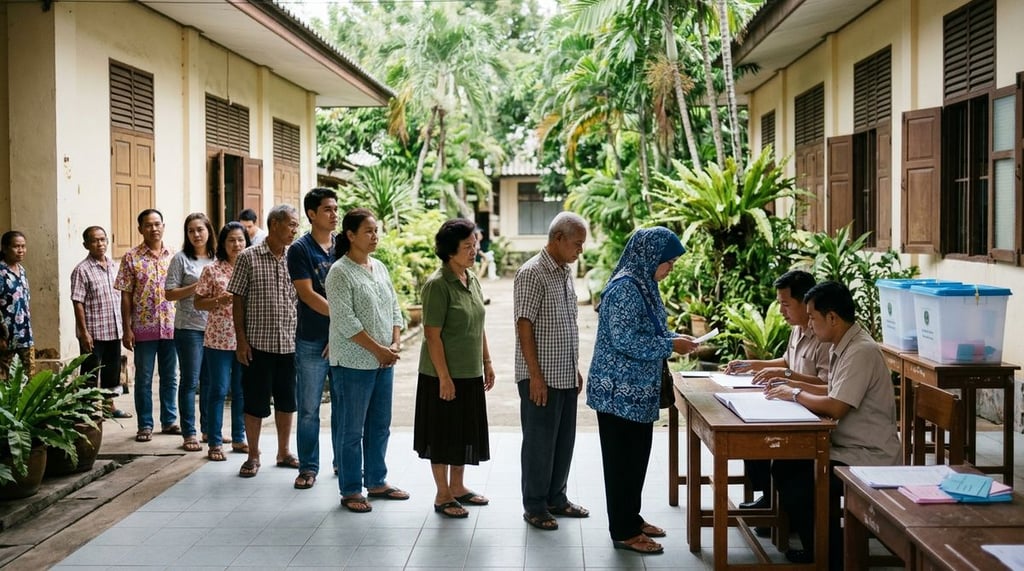
Citizens across Songkhla City Municipality cast ballots on Sunday in a mayoral by-election prompted by the early resignation of the former municipal chief. Polling commenced at eight in the morning across seventy-three designated voting precincts, drawing a steady flow of electors before booths closed at five in the afternoon. Provincial election authorities and municipal monitors described balloting as peaceful, orderly, and entirely devoid of procedural disruption.
The local contest holds outsized political significance for the lower southern peninsula. Encompassing the historic port district of Bo Yang and forty-one thousand registered electors, the municipality serves as the administrative, judicial, and cultural heart of Songkhla province, operating alongside the larger commercial center of neighboring Hat Yai. With municipal governance central to infrastructure preservation, tourism revitalization, and port management, Sunday's civic turnout reflected intense community engagement in local administration.
Civic Mobilization and the Songkhla Model
Electoral logistics were executed with disciplined precision under the oversight of the Election Commission of Thailand. National election commissioner Sittichote Intharawiset traveled to Songkhla ahead of polling day to supervise the staging of ballot boxes and security seals from the gymnasium at Tinsulanonda Stadium. The commission framed the exercise as a regional benchmark, designated the Songkhla Model, aimed at demonstrating high standards of administrative readiness, ballot integrity, and weather resilience for local elections across Thailand.
Provincial election director Thanakrit Nakjarupong and Songkhla police chief Police Colonel Keerati Triwai coordinated security across all seventy-three voting venues. Polling station number one, located at Tessaban 4 Ban Laem Sai School along Ratchadamnoen Road, opened on schedule following a formal national anthem ceremony. Provincial police officers coordinated with military police from the Royal Thai Navy Second Naval Area Command, while two rapid-response units patrolled the urban perimeter to prevent voter intimidation or unlawful campaigning.
A Three-Way Factional Battle for Municipal Clout
While four individuals originally filed for the mayoral office, the contest distilled into a tripartite rivalry after election officials confirmed that candidate number three, Chonrak Tantiseranee, did not advance to the ballot. The remaining contenders represented three distinct currents of southern local politics, combining established family networks, bureaucratic incumbency, and party-backed reformist organization.
Candidate number one, Wanchai Parinyasiri, campaigned to reclaim the municipal leadership after stepping down earlier this year to renew his mandate. Wanchai emphasized continuity in urban drainage works and completed waterfront projects. Facing him on ballot number two was veteran municipal leader Somsak Tantiseranee, known locally as Nayok Bao, whose campaign drew on grassroots ties among merchant households and neighborhood elders. Candidate number four, Kriangkrai Khomkham, led the Nakhon Songkhla Kao Na progressive ticket with backing from civic groups and Democrat Party figures, advocating for administrative digitization, transparent procurement, and municipal support for youth entrepreneurship.
Coastal Economy, Tourism Assets, and Municipal Mandates
Beyond the personal rivalry of local contenders, Sunday's vote carries immediate structural consequences for Songkhla's municipal finances. Unlike Hat Yai, which functions as a private commercial and retail transit junction, Songkhla City Municipality centers on heritage preservation, civil administration, marine fishing commerce, and academic institutions. The municipal budget oversees critical public assets stretching along Samila Beach, the Tang Kuan hill funicular, and the Sino-Portuguese shophouses of Nang Ngam and Nakhon Nok roads.
Restoring foot traffic to Songkhla Old Town has emerged as a central test for the incoming administration. While international travelers frequently bypass the provincial seat for Hat Yai duty-free hubs or the Andaman coast, the municipal council manages zoning laws, sanitation, and street preservation essential to sustaining boutique tourism. Concurrently, environmental protection along the mouth of Songkhla Lake and localized shoreline erosion require substantial municipal capital, forcing candidates to reconcile ambitious civic welfare pledges with finite local tax revenues.
What This Means for Local Governance and Foreign Residents
For expatriates, retirees, and foreign academics residing within the municipal perimeter, the orderly execution of Sunday's poll underscores the institutional stability of southern municipal administration. Foreign residents in Bo Yang, many of whom teach at regional universities or live in restored heritage houses, rely directly on municipal services ranging from residential building permits and sanitation to beachfront park upkeep and local civil defense.
A stable municipal executive in Songkhla ensures predictable administrative continuity. Mayoral leadership determines urban planning enforcement, traffic routing along coastal thoroughfares, and municipal clinics that serve mixed households. Furthermore, the successful rollout of the Songkhla Model demonstrates that local democratic institutions in the south operate with professional rigor, reinforcing commercial confidence for hospitality ventures, maritime logistics operators, and property owners across the provincial capital.
Comment verification
Step 1 of 3
Verify your email once to publish your comment. Your email is never shown publicly.
Enter the 6-digit code sent to .
Choose the display name shown next to your comments.